
Double Membrane Gas Holder Burst – Is It an Explosion? – 800m³ Flour Mill Biogas Case Study
An anaerobic digester is basically a “large sealed tank” specially designed to treat variouWhen you hear that a double membrane gas holder has “burst,” it’s natural to picture flames and smoke. That’s a normal reaction – the word “burst” itself carries a lot of alarming associations.
But the reality is often different from what we imagine.
This case is exactly that – a story that sounds dramatic but is actually quite simple. An 800m³ double membrane gas holder that had been running for just one year failed. The membrane tore. The project was shut down.
Some called it an “explosion.” Others said “burst.” A few even spread rumours of a major safety incident.
So what really happened? We’ll explain it in three parts.
Part One: A quick reassurance – this is not what you fear when you hear “explosion.”
Part Two: Why it actually failed – tracing the problems back to the design phase.
Part Three: How we fixed it – removing the old holder and installing a new one, eliminating the root cause.

Part One: Double Membrane Gas Holder Safety – Not the “Explosion” You Fear
When many clients hear that an 800m³ double membrane gas holder “burst,” their first reaction is concern – about site safety, potential injuries, or an uncontrollable accident. That’s completely understandable. The word “explosion” naturally evokes images of intense combustion, shockwaves, and devastating consequences.
But please rest assured: what happened here is entirely different from that kind of “explosion.”
To help you understand, here’s an analogy:
The kind of “explosion” you worry about – that’s like a combustible gas mixing with air in a confined space, finding an ignition source, and triggering a violent chemical reaction. In engineering terms, this is called a chemical explosion.
It requires three conditions at the same time: ① biogas leaks and mixes with air to reach its explosive limit (methane’s explosive range is approximately 5%–15% by volume); ② an ignition source is present (open flame, electrical sparks, static, etc.); and ③ the space is confined, allowing pressure to build. All three conditions must be met.
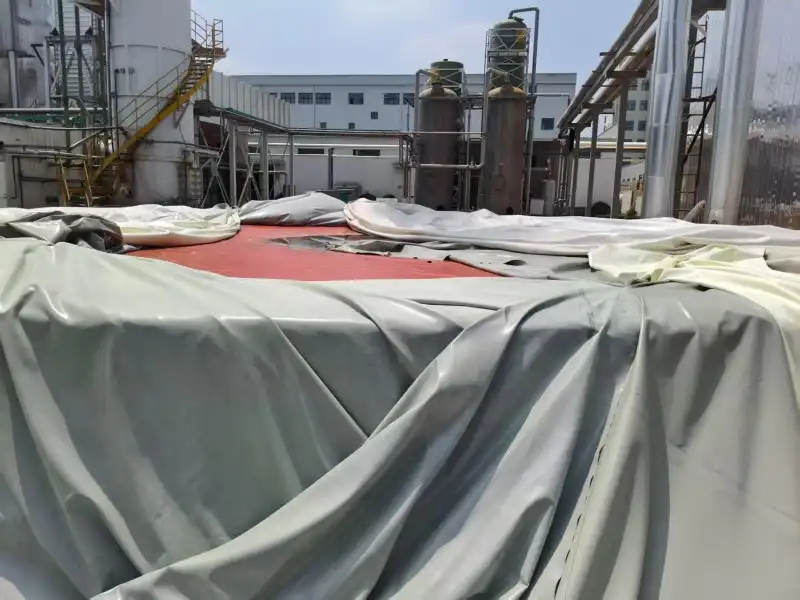
What actually happened to this 800m³ biogas dome – it’s like blowing up a balloon. You keep inflating it, and at some point it can’t take any more – it just pops. No fire. No combustion. No shockwave. Just a purely physical over-pressure failure. The inner membrane exceeded its design limits – the material simply gave way under excessive force.
[Left: 800m³ double membrane gas holder burst site photo]
So please understand: this incident did not involve any combustion reaction between biogas and air, nor any ignition source. The double membrane gas holder membrane failure was caused by material overload – a physical rupture. In safety engineering, this is fundamentally different from a “chemical explosion.” There was no fire. No one was injured. And there was never an uncontrollable safety incident.
Part Two: Biogas Plant Design Flaw – The Real Cause of Failure
Now that we’ve established it wasn’t an explosion, let’s look at why this 800m³ double membrane gas holder actually failed.
This biogas holder had been in operation for about a year before the failure. During that time, it appeared to be working normally. But in reality, it had been operating with dangerously insufficient safety margins from day one.
Under normal conditions, it barely held up. But every fluctuation in biogas production pushed it closer to its limit. Over time, the accumulated stress finally exceeded its capacity during a momentary peak in gas output – and the membrane gave way.
This was not an operational issue. It was a design flaw buried in the engineering phase.
Our on-site investigation and operational data analysis revealed the root cause: the original supplier failed to match the biogas holder’s safety relief system to the actual gas production characteristics of the flour mill’s biogas plant.
A critical point to understand: flour mill biogas projects inherently produce gas with high instantaneous peaks and significant fluctuations – this is a fundamental process parameter that any competent designer should anticipate and account for. This is not an “extreme condition” that was impossible to foresee. The original supplier had every opportunity – and the responsibility – to obtain these basic operating data and incorporate them into their design calculations.
According to biogas plant design standards, the gas holder system must be equipped with pressure relief devices – such as safety valves, emergency venting valves, and associated vent pipes – with sufficient capacity to quickly release excess gas when the holder approaches its pressure limit.
However, the original supplier failed to perform proper sizing calculations based on the flour mill’s fluctuating biogas output. The vent pipe diameter they specified was significantly undersized. The maximum discharge capacity per unit time was far less than the instantaneous peak gas flow rates that frequently occurred in the actual operation.
In other words, even when the safety valves fully opened, the gas simply couldn’t escape fast enough through the undersized vent pipes. The entire overpressure protection system was effectively useless in preventing pressure build-up.
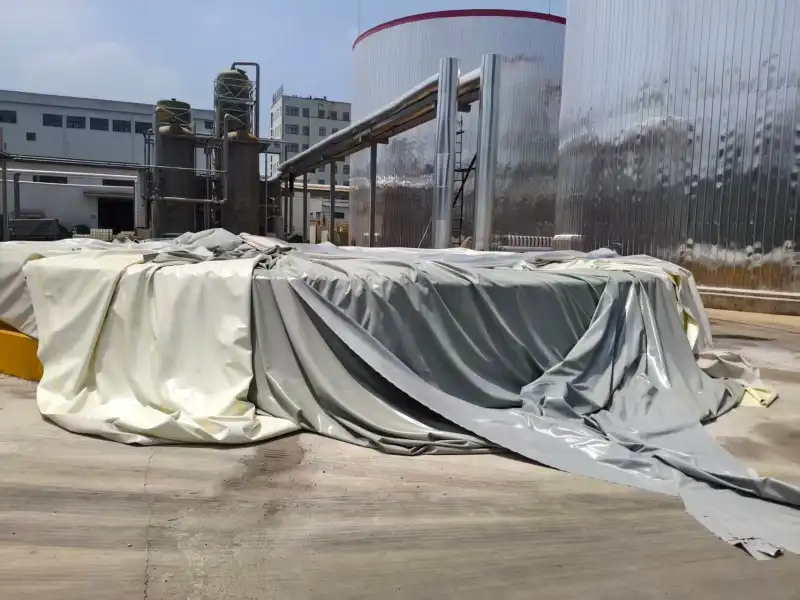
[Right: 800m³ double membrane gas holder burst site photo]
This design flaw meant the biogas holder had been operating in a critical state from the very first day – it worked temporarily, but it was never truly safe. And when an unexpected peak finally arrived, the holder failed.
In short: this 800m³ double membrane gas holder didn’t “explode” – it was over-inflated until it burst. The original supplier failed to size the system for the inherent gas production fluctuations of a flour mill biogas plant. The safety relief valves and pipes were too small. The discharge rate couldn’t keep up with the incoming gas flow. The biogas storage system was dangerous from day one – it just took a year of operation before that danger became reality.
Part Three: Biogas Storage Solution – Remove the Old Holder, Install the New
This incident was a physical over-pressure failure caused by a design and sizing defect – not a chemical explosion, and not an operator error.
The fact that this 800m³ double membrane gas holder operated for a full year before failing actually shows that the daily operation and maintenance were well managed. But it also proves that the system lacked adequate safety margins from the start – there was no real safety buffer. It simply waited for a peak gas surge that would push it past its breaking point.
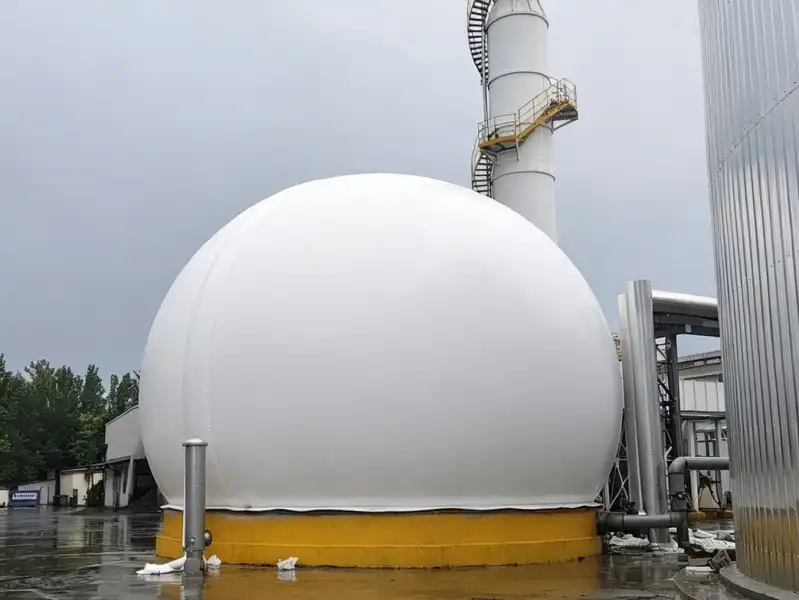
In handling this project, our team removed the old 800m³ gas holder entirely. We then re-calculated and re-sized all key parameters – including safety relief pipe diameter and biogas storage capacity – based on the actual gas production characteristics of this flour mill.
Haiyue installed a brand new 800m³ double membrane gas holder with sufficient safety redundancy, completely eliminating the risk of recurrence.
If you are facing similar challenges – double membrane gas holder selection, retrofit, or new biogas plant planning – please feel free to contact us for professional technical advice.